
XJTU's first Science paper of 2026: Breakthrough in perovskite solar cells
In a significant advancement for perovskite solar cell technology, researchers have developed a novel strategy to overcome key challenges in the field, as detailed in the first Science publication of the new year. The study, titled "Molecular Press Annealing Enables Robust Perovskite Solar Cells," was published online on January 9. It marks a major breakthrough by a team from Xi'an Jiaotong University in collaboration with Xiamen University.
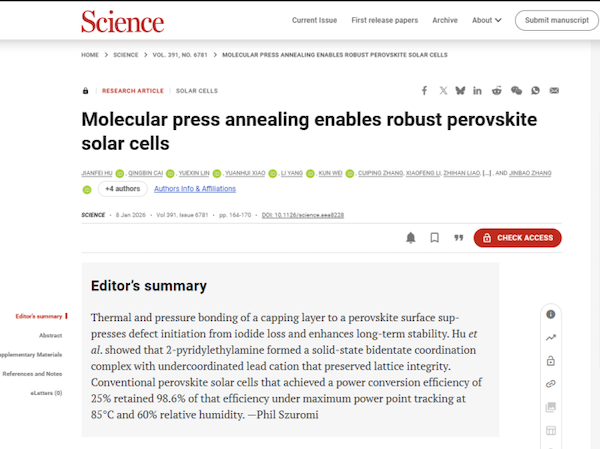
Perovskite photovoltaic materials have gained attention for their high efficiency and low production costs, offering promising prospects for next-generation solar cells. However, the essential thermal annealing process used in device fabrication often leads to surface defects and structural degradation, particularly iodine vacancies, which degrade the perovskite structure. This process exacerbates lattice disorder, ion migration, and detrimental self-doping effects, ultimately reducing device performance and stability.
To address these issues, Professor Liang Chao's team from Xi'an Jiaotong University and Professor Zhang Jinbao's team from Xiamen University introduced a new Molecular Press Annealing (MPA) strategy. This method involves imprinting a dense layer of pyridine-based molecular templates onto the perovskite surface during thermal annealing, without introducing solvents. The carefully designed ligand molecule, 2-pyridylethylamine, forms a stable bidentate coordination with under-coordinated lead ions, stabilizing the lead-iodine framework and effectively inhibiting iodine vacancy formation and diffusion.
This strategy resulted in perovskite films with high crystallinity and low defect density, significantly enhancing charge transport and collection efficiency. The n-i-p structure perovskite solar cells achieved a certified efficiency of 26.5% for small-area devices (0.08 cm²), 24.9% for 1 cm² devices, and maintained 23.0% efficiency for 16 cm² modules. The devices also demonstrated exceptional long-term stability, retaining over 98% of initial efficiency after 1,600 hours under 85°C and 60% relative humidity (ISOS-L-3 standard) and showing negligible performance degradation after over 5,000 hours in ambient storage (ISOS-D-1 standard).
The research was supported by various funding bodies, including the National Key R&D Program of China and the National Natural Science Foundation of China. Xi'an Jiaotong University served as the corresponding author institution, with PhD student Lin Yuexin as a co-first author and Professor Liang Chao as the corresponding author. Professors Zhang Jinbao and Yang Li from Xiamen University were co-corresponding authors. The study also benefited from the analytical support of Xi'an Jiaotong University's testing center.
-

XJTU holds 2026 New Year Concert
December 30, 2025