XJTU team achieves breakthrough in fatigue-resistant metal film conductors
Flexible electronics have broad application prospects in fields such as aerospace, human-machine interaction, biomedical engineering, and clean energy. Metal thin films, as key conductive materials, play a central role in electrical connection and signal transmission. However, they have long faced fatigue problems caused by cyclic deformation in practical applications.
Traditional nanocrystalline metal thin films are prone to abnormal grain growth and strain localization, leading to premature initiation and rapid propagation of fatigue cracks, causing sharp increases in resistance and even complete circuit failure.
Although methods such as alloying and multilayering can improve the high-cycle fatigue resistance of thin films, they often sacrifice electrical ductility and low-cycle fatigue life, making it difficult to achieve synergistic optimization. This bottleneck restricts the service life and functional stability of flexible electronic devices, posing a core obstacle to their engineering application.
Facing this long-standing challenge, a team led by Academician Sun Jun from the State Key Laboratory for Mechanical Behavior of Materials at Xi'an Jiaotong University (XJTU) proposed a design strategy of coherent gradient nanolayered architectures.
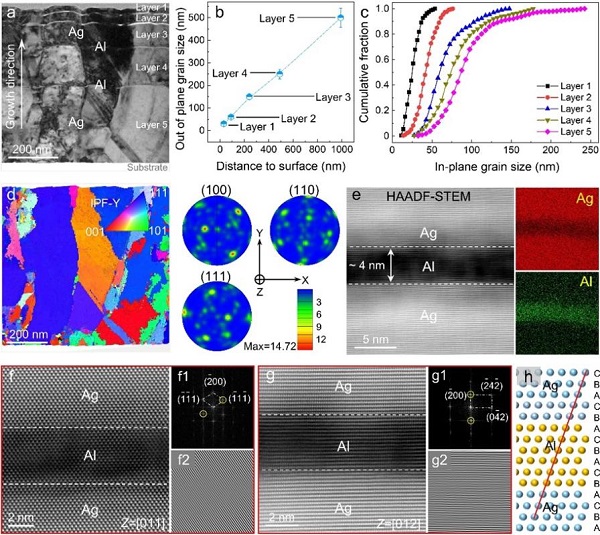
By constructing metal multilayer films with atomic-level coherent interfaces and stepwise gradient transition characteristics, they achieved synergistic inhibition of the entire process of fatigue crack from initiation to propagation, providing a new solution for the long-term service of flexible conductors.
The team used magnetron sputtering technology to prepare coherent gradient nanolayered thin films with alternating stacking of silver (Ag) and aluminum (Al). This structure has the following core innovative features: (1) Atomic-level coherent interfaces between Ag and Al promote dislocation cross-interface slip, relieving interface stress concentration and thus delaying interface crack initiation; (2) Stable nanoscale Ag layers on the surface inhibit the formation of surface cracks; (3) Mechanically stable coherent interfaces and thickness gradient structures work synergistically to induce heterogeneous deformation strengthening effects, guiding grains to undergo beneficial lateral (parallel to the layer interface) coarsening under cyclic loading, inhibiting through-thickness structural instability, and further delaying fatigue crack initiation; (4) Moderate interfacial bonding strength and multiaxial stress states induced by gradient structures jointly promote interface delamination and crack deflection, inhibiting fatigue crack propagation.
Performance tests show that Ag/Al coherent gradient multilayer films maintain a high conductivity of approximately 107 S/m after more than 107 cycles over a wide strain range (0.7 percent–2.0 percent); even under 5 percent large strain fatigue conditions, after 105 cycles, their electrical conductivity remains superior to 106 S/m.
The comprehensive fatigue resistance of this material is better than that of previously reported similar metal thin film materials, achieving synergistic improvement of high-cycle and low-cycle fatigue performance.
While endowing the material with extraordinary fatigue resistance, this coherent gradient layered structure maintains a high conductivity and good electrical ductility close to that of pure silver films.
This design concept has good universality and can be extended to other metal systems such as gold, copper, and aluminum, and is highly compatible with existing microfabrication technologies, demonstrating excellent industrial application potential.
The research team further prepared three types of prototype devices: implantable bioelectrodes, flexible light-emitting displays, and flexible interconnect circuits, verifying the feasibility of this thin film conductor material in multiple cutting-edge fields.
This provides a practical path to break through the long-term reliability bottleneck of flexible electronics, and is expected to promote the in-depth application and popularization of flexible electronic technology in fields such as healthcare, human-machine interaction, and intelligent sensing.
The relevant research results were published online in Nature Electronics under the title Fatigue-resistant metal-film-based flexible conductors with a coherent gradient nanolayered architecture.