XJTU breakthrough recognized in China's top neuroscience advances
The Chinese Society for Neuroscience recently announced the top 10 advances in Chinese neuroscience in 2025, selecting a fundamental research achievement led by Professor Wang Changhe from the School of Life Science and Technology at Xi'an Jiaotong University (XJTU), titled Sexually dimorphic dopaminergic circuits determine sex preference.
Social interaction is an instinctive behavior in humans and higher animals, with organisms needing to dynamically adjust their social decisions in response to changes in external survival environments and internal physiological needs to maximize benefits. However, the neural coding mechanism underlying this process remains unclear.
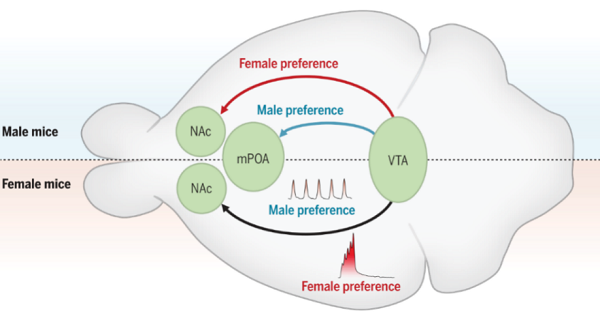
Professor Wang's team found that, under normal physiological conditions, both male and female individuals exhibit a female social preference. However, when faced with life-threatening situations, this preference shifts to a male preference.
The team found that midbrain dopamine neurons precisely regulate dopamine secretion patterns through distinct firing modes. These neurons encode social preferences via biased synaptic transmission: phasic dopamine secretion mediated by dopamine D1R receptors promotes female preference, while tonic dopamine secretion mediated by dopamine D2R receptors promotes male preference.
This work establishes a new theoretical model of biased synaptic transmission in dopamine neurons, revealing the neural coding mechanism of social decision-making and its integration with sexually dimorphic neural circuits.
The findings offer a new perspective on the neural basis of social behavior and provide insights into neural circuit mechanisms that integrate external environmental and internal physiological signals to regulate instinctive behaviors. They also offer a theoretical foundation for understanding the sexually dimorphic pathological mechanisms of related brain disorders.
This research was published online in Science on Jan 10, 2025. It was specially recommended by Science, featured in two highlight reviews, and highlighted in Nature Reviews Neuroscience. It has also been selected as a Web of Science Highly Cited Paper.
-
XJTU team achieves breakthrough in zinc-based flow batteries
December 30,2025
-
XJTU and Hong Kong Polytechnic University achieve breakthrough in energy storage dielectrics
December 18,2025
-
XJTU research team reveals North Atlantic Subtropical High's dominance over tropical hydroclimate
December 16,2025