
XJTU team achieves breakthrough in cell membrane fluidity analysis
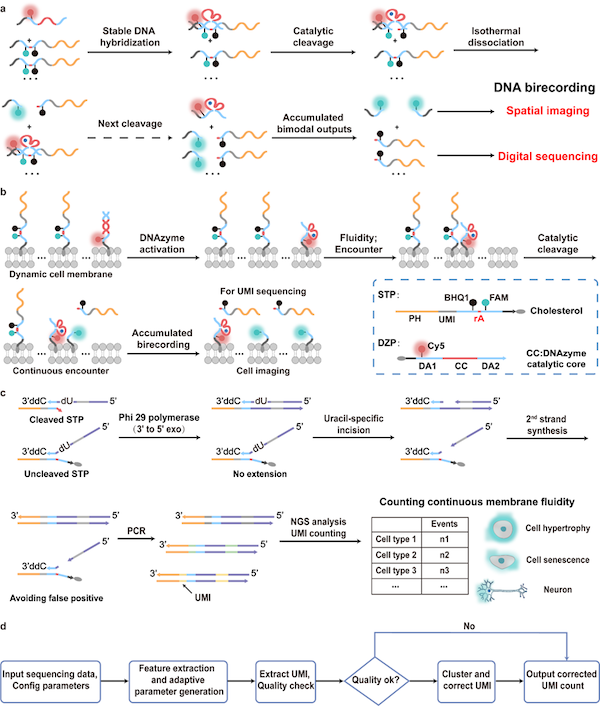
The architectural design of BioDIMER.
A research team led by Professors Zhao Yongxi and Chen Feng from Xi'an Jiaotong University (XJTU) has developed the Biophysical-to-DNA Catalytic Cumulative Birecorder (BioDIMER), which integrates dynamic DNA nanotechnology with unique molecular identifier (UMI) sequencing to achieve dual-mode, cumulative recording of continuous events in live cell membrane fluidity. This enables both spatiotemporal visualization through fluorescence imaging and digital absolute quantification via DNA sequencing.
The BioDIMER system's core consists of a pair of membrane-anchored DNAzyme probes that, upon encountering each other via membrane fluidity, catalyze a cleavage reaction, thereby generating an in situ fluorescent signal and a DNA fragment bearing a unique UMI.
The in situ fluorescent signal forms a dynamic fluorescence image, while the DNA fragment enables digital quantification of events. Thus, the addition of new events does not overwrite previous records, thereby ensuring the integrity and continuity of the history of membrane fluidity.
Based on this technology, the researchers analyzed the differences and patterns of membrane fluidity across various cell types and states, including temporal changes during the cell cycle (G1, S, G2 phases), significant enhancements of membrane fluidity in a cardiac hypertrophy model, decreased fluidity during myotube differentiation, and reduced fluidity caused by cellular senescence.
The researchers envision applying this method to extend dynamic monitoring to other membrane structures, such as organellar membranes (e.g., the endoplasmic reticulum and mitochondria) and extracellular vesicles (EVs). They also discuss the feasibility of integrating this technology with multi-round combinatorial imaging, flow cytometry, and single-cell sequencing.
This innovative technology provides a powerful tool for continuously analyzing cell membrane dynamics at the single-cell level, revealing relationships with the cell cycle, disease states, and developmental processes, and holds significant potential for applications in fields such as cell biology, cardiac hypertrophy, and aging research.
This work, titled Biophysical-to-DNA Catalytic Cumulative Birecorder for Measuring Continuous Membrane Fluidity, was published in the Journal of the American Chemical Society.
-

XJTU holds 2026 New Year Concert
December 30, 2025