
XJTU team achieves breakthrough in perovskite-based optoelectronic memristors
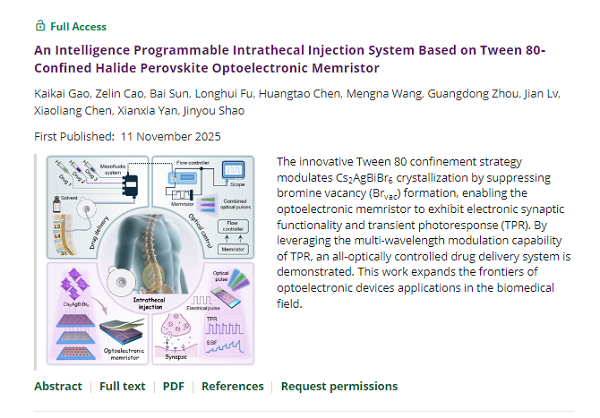
A research team led by Professor Shao Jinyou and Professor Sun Bai from the Frontier Institute of Science and Technology, Xi'an Jiaotong University (XJTU), proposed a novel restriction strategy for the nucleation of perovskite Cs2AgBiBr6 using the dual-hydrophilic and dual-hydrophobic long-chain surfactant "Tween 80".
By employing in-situ characterization techniques and first-principles calculations, the team proposed a kinetic model that specifically inhibits the formation of bromine vacancies. The hydrophobic part of Tween 80 (oleic acid chain + ester group) suppresses the formation of bromine vacancies at the source.
According to the soft and hard acid-base theory, silver and bismuth ions can form stable coordination bonds with the ester oxygen atoms. This coordination effectively "locks" the metal cations at the center of the octahedron, mitigating the coordination collapse caused by thermal vibration or lattice strain, thereby reducing the driving force for bromine ion desorption.
Additionally, the hydrophilic part of Tween 80 (PEO chain) can anchor bromine ions through dipole-anion interactions at the octahedral bridging sites. Computational results show that the formation energy of the system is negative when individual C, H, and O atoms in the PEO chain interact with the octahedral bridging sites of the perovskite (Abs-C = -1.58 eV, Abs-H = -0.46 eV, Abs-O = -1.53 eV), indicating that the adsorption of these atoms onto the perovskite crystal structure is a thermodynamically spontaneous process.
The adsorption of PEO chains on the crystal surface creates steric hindrance, modulating the crystallization rate and providing sufficient time for bromine ions to diffuse into ordered lattice sites, further inhibiting the formation of bromine vacancies.
By precisely controlling the degree of Tween 80 encapsulation, the research team fabricated Cs2AgBiBr6 films with large grain sizes, no pinholes, high crystallinity, and ultra-high photoluminescence intensity.
To evaluate the performance of these films in optoelectronic devices, the team prepared perovskite-based optoelectronic memristors using a vertical stacking process. These memristors exhibit both electronic synaptic functionality (ESF) and transient photoresponse (TPR) characteristics.
Under electrical stimulation, the ESF achieved a recognition accuracy of 91 percent in MNIST tasks. Under optical stimulation, it demonstrated a TPR with a 20-millisecond response time, ultra-long durability of 931.7 milliseconds, and over 103 stable cycles at 5 hertz.
In terms of applications, the prepared optoelectronic memristors enabled all-optical writing and erasure through multi-wavelength light pulse programming, capable of performing complex all-optical image processing tasks.
The authors also demonstrated an all-optically controlled intrasheath drug injection system based on the optoelectronic memristor, which can support up to six specific drug release strategies. This work provides a reference for the encapsulation process and theoretical support for regulating perovskite nucleation, while also showcasing the application prospects of optoelectronic memristors in all-optically controlled intrasheath drug injection systems.
The research findings were published in the prestigious international journal Advanced Materials.
-
XJTU and Xidian University researchers achieve breakthrough in 3D-printed high-performance piezoelectric materials devices
November 30,2025
-
XJTU-USTC research team achieves breakthrough in pressure-sensitive phosphorescent polymers for smart materials
November 26,2025
-
XJTU and University of Cambridge achieve AI breakthrough in digital pathology
November 24,2025