
XJTU-USTC research team achieves breakthrough in pressure-sensitive phosphorescent polymers for smart materials
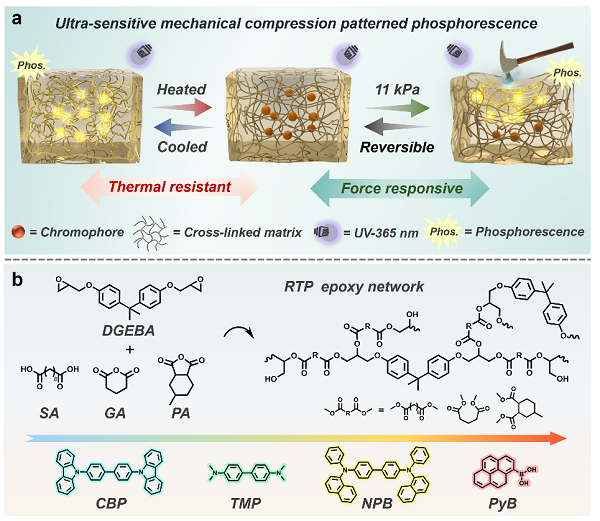
The schematic and chemical design of an efficient, room-temperature phosphorescent, dye-doped cross-linked epoxy resin.
A research team led by Professor Zhang Yanfeng from the School of Chemical Engineering and Technology at Xi'an Jiaotong University (XJTU) and Professor Zhang Guoqing from the University of Science and Technology of China's (USTC) Hefei National Laboratory for Physical Sciences at the Microscale recently released a dye-doped cross-linked epoxy resin material that exhibits clear patterned phosphorescence under mechanical compression.
By incorporating pure organic chromophores into epoxy resin matrices with different glass transition temperatures (Tg), the researchers discovered that the phosphorescence emission temperature range could be controlled by adjusting the Tg of the epoxy resin.
The material demonstrated significant long-lived phosphorescence even at temperatures up to 150 C. In the rubbery state of the cross-linked network, the material exhibited a sensitive, spontaneous, and reversible phosphorescence response to mechanical compression.
This study developed a dye-doped cross-linked epoxy resin material capable of achieving sensitive, patterned mechanical compression phosphorescence. The material system not only exhibits full-color room-temperature phosphorescence but also maintains stable phosphorescence emission at high temperatures.
By tuning the Tg of the epoxy resin matrix, the phosphorescence intensity and afterglow duration of the system could be effectively regulated. Most notably, in the rubbery state of the cross-linked network, the material's phosphorescence intensity showed a sensitive, reversible, and quantitative response to compressive stress.
This mechanical compression phosphorescence method, which combines non-destructive, reversible, and patterned characteristics, provides new design ideas and feasible strategies for developing the next generation of mechanically responsive smart phosphorescent materials.
The work, titled Sensitive mechanical compression-patterned phosphorescence in the rubbery state of cross-linked polymer network, was published in Nature Communications.
